Some sales are not really sales. When demand outnumbers supply by a factor of five or ten, the event is practically sold out before the ticket shop opens, and the on-sale is essentially an allocation carried out at speed. The decisions that shaped the sale were made weeks in advance: how many tickets to release, how many dates or sessions to open, where to set the price tiers, and how much to hold in reserve for members, partners, and VIPs. These factors are decided without knowing for sure how many people will show up to buy tickets. A ticket ballot can give you what you need to get more out of high-demand ticket sales.
What a high-demand sale looks like today
Weezevent has been running these for years. AC/DC’s only French date after eight years away sold out in fifty minutes, peaking at a hundred tickets a second with 200,000 people connected at once across 450 servers. Hellfest, Ye or the PlayStation 5 launch all follow the same pattern.
The virtual queue makes that possible by triggering when demand crosses a threshold you set. The queue holds prospective buyers in a controlled waiting room and releases them into the shop in batches, which protects the infrastructure and the buying experience at the same time. You can control when the queue opens, how many people it lets through at a time, how many it holds, and what they see while they wait.
What a queue cannot tell you
A queue shows you the demand as it arrives. You can watch 200,000 people connect, see how fast the shop drains, and know within minutes that you could have sold out several times over. And even though that’s great news, it also means that you’ve lost something too.
Prospective ticket buyers who did not reach the shop leave nothing behind. And you’re left without their contact details or any idea how many times they tried to connect to the shop. You also have no indication of what date, time slot, or seat they would have preferred and whether they would have been happy with an alternative date once their first choice was sold out.
The sheer volume of people in the queue confirms there was demand, but says nothing about who they were, where they were, or what they would have accepted instead. Those are the things that could have helped you change the decisions you made weeks earlier. To find out, you can use a ballot, which turns your demand into named applications before you commit to anything.
How a ballot works
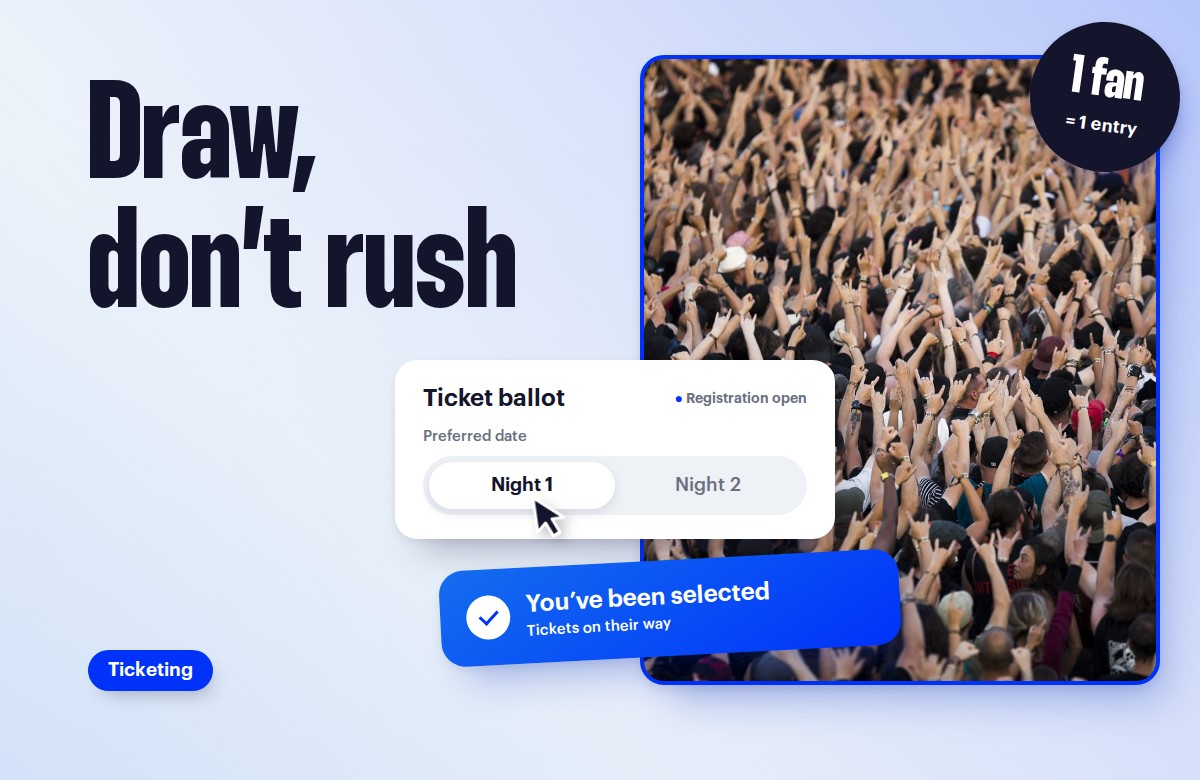
A ticket ballot lets fans apply through a form during a registration window. When it closes, we remove any duplicate and suspicious entries and draw the allocation.
How the money moves is your choice, and it is worth settling before registration opens. There are two options for this:
1. Reserve the funds during registration
You can reserve the full order amount during registration. Registrants then choose their tickets exactly as they would in a normal basket, picking category, price band and quantity, and then leave a card imprint. Nothing is charged unless they are drawn. Everyone selected for a ticket is charged automatically and receives their tickets; everyone else is told they were not selected, and nothing is taken from them.
This is the cleanest version to operate and doesn’t require a second step to convert. The fan knows exactly what they asked for and what it would cost, so the only remaining question is whether they get in. The trade-off is that a card imprint asks more of an applicant than an email address, so some of the lighter interest drops out.
2. Take payment later
The second option is to keep the form light and take payment later. Successful registrants receive a code and a window in which to buy. Usually this means far more people register for the ballot because applying costs nothing. The benefit is that you learn more about the real size of the interest, and you build a longer list. In exchange, you’ll inevitably lose a share of the people you selected, and you’ll need a reserve list to cover the drop in conversion from the primary selected group.
What you get out of it
The size and shape of the demand
Registrations tell you exactly who wants to attend, where they are, which dates or sessions work for them, and which price bands they were prepared to take, all before you have committed to anything. That gives you room to consider opening a second date, releasing another block, or changing how you divide ticket availability between members, presale, and general sale. It’s much easier to make those calls in advance with the numbers in front of you than afterwards.
No rush to absorb
There is no rush during which everyone arrives looking to be first in line for a ticket. Instead, registration can be spread over days; you can draw the ballot when you choose, and process payments on your schedule. It is the least demanding way to sell out an event, with no load spike, no waiting room, and no fans refreshing to see whether their payment went through.
Filtering
Screening happens between the close of registration and the draw, the one moment in the process when you can remove someone at no cost to anyone. We filter out duplicate identities, disposable email domains, known reseller accounts, and automation patterns before ticket allocation. Japan made resale above face value illegal in 2019, and the ballot system is now central to how that gets enforced.
A form you build, filled in by everyone who wanted to come
The registration form is yours, so you’re free to ask for information that is useful to you: which dates or sessions they can make, how many places, travelling from where, first visit or returning, accessibility needs, which stage or which match. Whereas a standard sale gives you data on people who completed a purchase, a ballot gives you data on everyone interested in attending. That’s a much larger pool of people who have opted in, and that is who you can reach out to if you want to open a second date.
Who is already doing this
Radiohead’s 2025 comeback tour ran entirely on registration. Fans signed up in every city on the tour, and only those who sent an unlock code could buy a ticket. Olivia Rodrigo’s GUTS World Tour drew randomly for access codes, and even after adding twenty dates, there were still more registrations than tickets. Oasis used an invitation-only ballot to give fans who had missed the reunion on-sale a second chance at two extra Wembley Stadium shows.
Outside touring, booking-slot draws handled access to Paris 2024, Eurovision 2025 and the Milan Cortina Winter Olympics, with Los Angeles 2028 planned the same way. In Japan, the model is simply how tickets are sold: a fan club lottery, then a general lottery, with first-come sale used for whatever is left over.
Running a ticket ballot
A ballot is more work than a normal peak sale, but it is work you can plan.
Registration runs three to seven days for most events. Longer windows rarely bring in more registrations, and they give automated sign-ups more time to accumulate. Anything you intend to use when you allocate has to be on the form, so you need to settle on the rules before registration opens and publish them with it. People accept a draw they understood in advance far more easily than one explained afterwards.
Cleaning up the registration entries happens between the close and the draw. The draw itself can be random or weighted. What happens next depends on the payment option you picked: cards are charged straight away, or codes go out with a purchase window of 24 to 48 hours. Either way, draw a reserve list at the same time so you can account for declined cards and unclaimed codes.
The step most teams underestimate is messaging the people who were not selected. They told you who they are and what they wanted, and they gave you permission to contact them. Telling them what happens next, whether that is returning their funds or announcing extra dates or events, is the cheapest audience work you will do all year.
Going beyond random allocation
Random allocation is straightforward and easy to explain, but equal odds are not always the right answer. Geography is a common reason to adjust them. For Sam Fender’s homecoming show in Newcastle, the ballot was weighted so that applicants from the North East of England were served first: a choice most fans could readily understand. Loyalty can be treated in much the same way. Spotify, for example, now identifies highly engaged listeners through Reserved Access. Your own records may be even more useful, particularly if attendance, membership, spending, and engagement are already logged in your CRM.
Whatever criteria you use, publish them via a dedicated FAQ when registration opens. Fans are far less likely to be understanding of a weighted ballot when they discover it was weighted after the draw.
What your ticketing platform must support
Look for four capabilities:
- One person must mean one entry, which requires named tickets and checks on accounts and payment methods.
- The form has to be yours to build, because the draw can only use what you collected.
- The draw has to follow rules you set, not just shuffle a list.
- You have to keep hold of the ticket afterwards, through named tickets, transfer limits, and official resale at face value on your own platform. Filtering duplicates, bots and scalpers out of a ballot counts for nothing if they get the tickets the next day.
Weezevent does all four, alongside the virtual queue, in the same system. The queue protects the sale. The ballot removes the need for one.
If you have a sale coming up that you already know will be oversubscribed, it is worth deciding now which of the two to run it on, because a ballot needs a few weeks of lead time that a queue does not.
Talk to the Weezevent team, and we will go through it with you.
With Weezevent, event organisers can simplify event management thanks to online ticketing, access control and advanced CRM tools. These solutions help professionals focus on delivering memorable experiences while ensuring events run smoothly in a fast-paced industry.