How modern ticketing helps improve conversion rates, boosting your ticket sales.
Conversion rate optimisation usually starts with ads, email campaigns, and social media promotions. Ticketing often comes later, treated as a “necessary step” once the decision is already made. In reality, ticketing is where intent becomes revenue. And every small friction at this stage compounds fast.
At Weezevent, we see it every day: organisers who improve their ticketing experience don’t just sell more tickets, they sell more efficiently, with better costs, learn faster, and build stronger relationships with their audience.
That is the thinking behind WeezTicket: a ticketing solution designed to fit naturally into an organiser’s website and workflow.
We work with organisers of every size: local workshops, shows, festivals, and conferences. Regardless of the event, the ticketing experience shapes how many people actually make it through the checkout.
Here are the main ticketing challenges that directly impact conversion, and how the right setup turns each one into a growth opportunity.
Summary
1. Boost your conversion rate directly on your website
The highest-converting ticket journeys share one important trait: they’re smooth.
Ticket buyers aren’t asked to create accounts, they aren’t redirected to unfamiliar platforms, and the experience works just as well on mobile as it does on desktop. There should be no roadblocks to break their momentum.
A critical element is having your ticket shop available on your website. Once a ticket buyer decides to make a purchase, the shop should be immediately available. Make sure your ticket shop is fully embedded into your website, or, at the very least, that the ‘Tickets’ button is clearly visible. That way, the focus stays on a single action: completing the purchase.
In practice, conversion improves when the checkout:
- Does not require an account
- Is designed mobile-first, optimised for thumb navigation
- Supports one-click payments such as Apple Pay, Google Pay and PayPal, which are proven to significantly reduce drop-off across many event types
- Collects ticket buyer information after payment, not before, reducing cart abandonment
The result is a smoother buying journey, fewer interruptions, and a noticeably higher completion rate, especially on mobile.
Use case
An independent festival drives most of its traffic from Instagram. On mobile, users tap “Buy ticket”, get redirected to an external platform, are asked to create an account, and eventually abandon the cart.
What changes conversion
When the ticket shop is fully embedded into your website, the experience stays continuous. As a ticket buyer, you don’t need to switch platforms, and there are as few steps as possible. Add Apple Pay, Google Pay or PayPal as payment options and many buyers will finish their purchase in seconds. Some organisers only collect essential details upfront, and collect the rest after payment. Doing so will often significantly reduce mobile cart abandonment.
Why it works
People buy tickets emotionally. Friction gives them time to second guess themselves.
2. Offer a fully customised purchasing experience
Conversion isn’t only about speed. It’s also about trust.
Buyers are more likely to complete their purchase when what they see matches what they were promised, and that can range from pricing to branding to general understanding of the product they’re purchasing. Any mismatch can cause hesitation and affect your conversion rates.
A fully customised ticketing experience helps organisers do this by:
- Accurately displaying complex pricing structures, such as tiers, bundles, memberships or discounts
- Customising every touchpoint, including checkout, e-tickets and confirmation emails to match your branding
- Integrating 2D or 3D numbered seating plans, which remove uncertainty and increase perceived value by giving the ticket buyer a sense of control
When the buying journey looks and feels like a natural extension of the event brand, rather than a generic ticket shop, trust increases, hesitation drops, and conversion follows.
Use case
A conference sells early-bird tickets, group passes, workshops and partner discounts. On a basic ticketing setup, this quickly becomes confusing for both buyers and organisers.
What changes conversion
The ticket shop is structured clearly instead of presented as one long list. Ticket categories make navigation easier, and dedicated ticket shops can be created for specific audiences (partners, members, general public), so each group only sees what’s relevant.
Early-bird or group discounts are applied automatically, keeping the logic simple and transparent. Add-ons are offered at the right moment in the purchase flow (after the main ticket is selected) reducing cognitive overload. For seated events, 2D or 3D seat maps allow buyers to visualise their seats before purchasing, giving the buyer a sense of control.
Why it works
Clarity converts. Confusion leads to hesitation which can lead to drop-offs.
3. Open up new sales channels
Conversion happens wherever and whenever your audience wants to buy a ticket, not just at home on a laptop. For many organisers, the real challenge is being present at the right moment, in the right place, through the right point of sale.
Modern ticketing makes it possible to sell tickets through multiple, complementary points of sale alongside your normal ticket shop:
- Partner and member-only sales through trusted organisations
- QR-code payment links displayed in physical locations, posters or social media
- Ambassador and referral programmes that let communities sell on your behalf
- On-site ticket offices for walk-ins and spontaneous demand
- Connections with national ticket resellers
Together, these channels increase the coverage of your event, making sure tickets are available at your audience’s convenience.
Use case
A theatre sells tickets online but realises that much of its audience discovers events through local shops, sports clubs, universities and word of mouth. Demand exists across the city, but tickets are only available in a single online shop.
What changes conversion
Local shops and sports clubs receive dedicated sales links or promo codes, allowing the theatre to measure exactly which partnerships generate the most ticket sales. Student ambassadors promote the event through unique tracking links within their communities. QR codes displayed in relevant venues allow for instant sales to interested visitors.
All of this is tracked using unique links and codes, so the theatre knows where their sales are coming from. Instead of relying on a single channel, the theatre builds multiple, measurable points of sale across the city and can clearly see which ones perform best.
Why it works
Ticket sales increase when availability matches audience behaviour. By creating more relevant points of sale, organisers lower the bar for entry into their sales funnel, and increase conversion.
4. Collect data that truly creates value
Not all data improves conversion, but actionable data does.
Advanced ticketing setups focus on collecting useful information. This information gives organisers a clear view of how ticket buyers move from first click to check-in, and where the hurdles are along the way.
In practice, this means you want to collect data in the following way:
- Custom buyer and participant forms tailored to each event
- Accurate performance tracking through native analytics solutions and pixels integrations
- Campaigns tracked across multiple channels
By doing so, you gain a structured understanding of the full buyer journey. With a built-in CRM layer, you can turn these insights into action: You can run more targeted email, SMS or WhatsApp campaigns, retarget more accurately, and make better pricing decisions over time.
Consistently collecting and utilising useful data leads to cumulative results, and you’ll find each of your events converts better than the last.
Use case
An organiser runs several events per year but struggles to understand which campaigns actually drive ticket sales, and which buyers keep coming back.
What changes conversion
Ticketing collects the right data, not just more of it. Custom forms collect information adapted to each event, while analytics and pixel integrations reveal which channels convert, which audiences return, and where drop-offs occur.
With built-in CRM tools, these insights turn into simple, targeted follow-ups: reminders for hesitant buyers, abandoned cart campaigns, student promotions, last-chance emails, early access for loyal attendees.
Why it works
Conversion improves when decisions are based on real buyer behaviour. Each event benefits from what was learned from the previous one, making performance more predictable and results more consistent over time.
5. Unlock new revenue opportunities
Improving conversion isn’t always about selling more tickets, sometimes it’s about selling more products or more often.
Ticketing can actively increase average order value through and boost your revenue through:
- Optimised cross-selling and up-selling
- Native ticket resale marketplaces, keeping demand and revenue inside your ecosystem
Use case
A festival consistently sells out, but revenue growth stalls. Ticket volume can’t increase, and raising prices risks hurting demand.
What changes conversion (and revenue)
Instead of pushing higher ticket prices, ticketing introduces relevant add-ons directly in the purchase flow:
- Parking options
- Camping/accomodation options
- Merchandise
- VIP upgrades
- After-parties
These extras are offered at moments when buyers are already engaged and committed, without adding friction or slowing down the checkout process.
When resale is inevitable, a native ticket resale marketplace keeps potential revenue from leaking to external platforms.
Why it works
The purchase decision is already made. Buyers are excited, so adding optional upgrades increases average order value without affecting conversion or attendance. Revenue grows without touching capacity or ticket pricing.
6. Extend the experience beyond ticketing
Conversion doesn’t stop at checkout, as the on-site experience directly impacts future sales. A seamless on-site experience reinforces trust and turns one-off buyers into loyal attendees through:
- Advanced access control (mobile, fixed, conditional access, photo display)
- Cashless NFC payments for food, beverages, and merchandise, reducing queues and increasing the average spend
When ticketing connects to access and on-site payments, organisers gain a full view of the event lifecycle, and participants enjoy a smoother, more memorable experience.
Use case
Entry queues are long, staff is overwhelmed, and on-site payments slow everything down. Instead of remembering the performances, attendees remember the problems and the waiting.
What changes future conversion
Ticketing is connected to fast, reliable access control and cashless payments for food and drinks. Entry flows better, queues shorten, and on-site spend often increases as a result.
Why it works
A smoother on-site experience directly shapes how people remember the event. When people spend less time in queues, satisfaction increases, and satisfied attendees are far more likely to return, recommend the event, and buy tickets earlier for the next edition.
Ticketing as a growth lever
With the right setup, ticketing become a conversion engine for your event that removes friction at the moment of purchase and uses data as the foundation to improve each new edition of your event. Importantly, ticketing can act as a growth lever that boosts your revenue without increasing complexity. Over time, it can also help strengthen the relationship between organiser and visitor, from edition to edition.
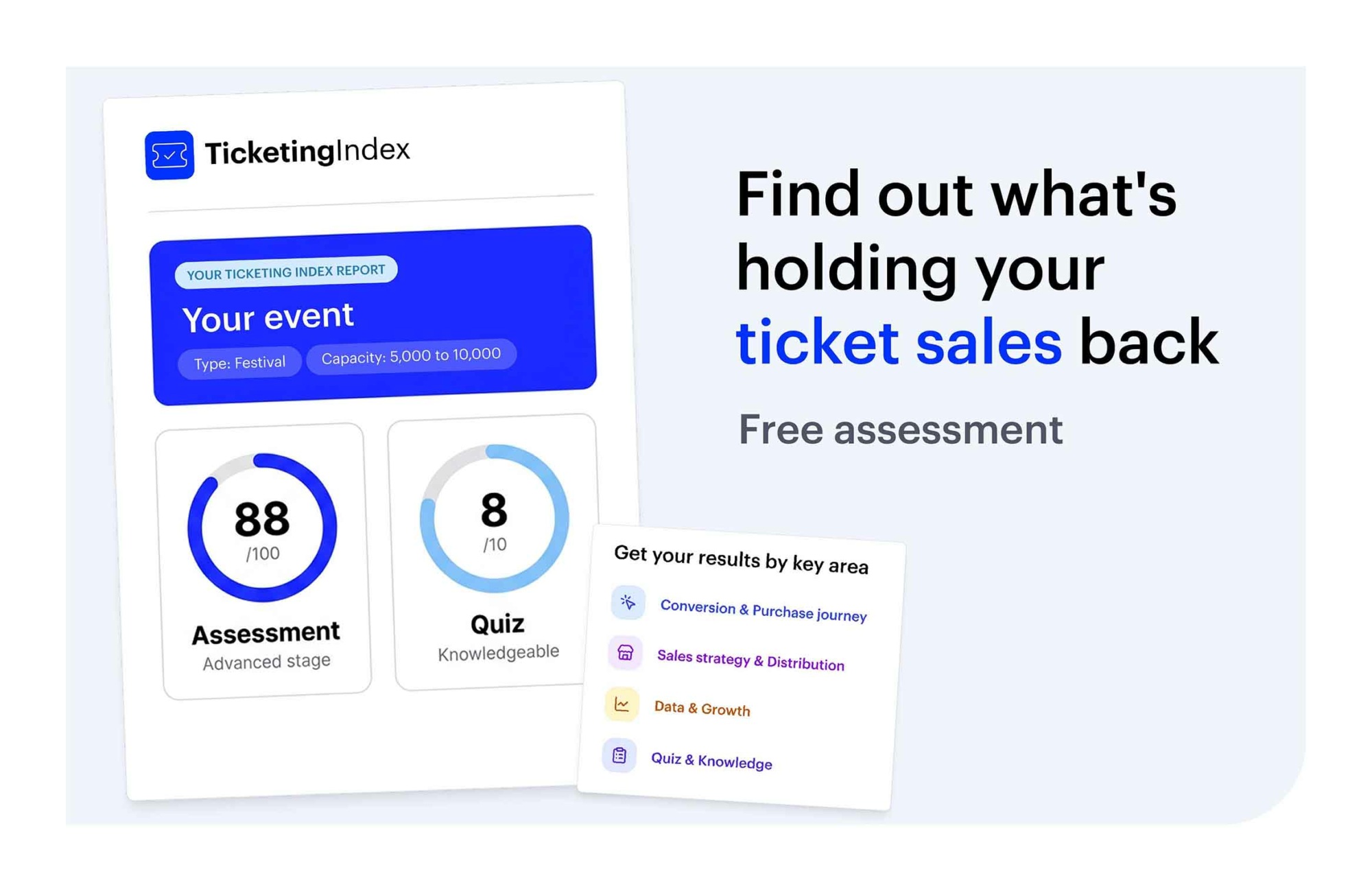
Ultimately, when ticketing does its job quietly and reliably, it stimulates the growth of your events by reducing friction across the board. The Ticketing Index helps you see if your current setup is aligned with your goals in just 5 minutes. See what makes purchasing easier, what may be costing you sales, and which levers to prioritise.
Your event is unique, and your ticketing should be too. Talk to our experts to design your custom setup.