The moment tickets go on sale for an event is always exciting. But a ticketing setup that sells is not necessarily one that converts to its full potential. Somewhere in your checkout flow, your post-purchase e-mail, your pre-sale setup, or all three at once, buyers are dropping off, data is being lost, and revenue that was already within reach is going unearned.
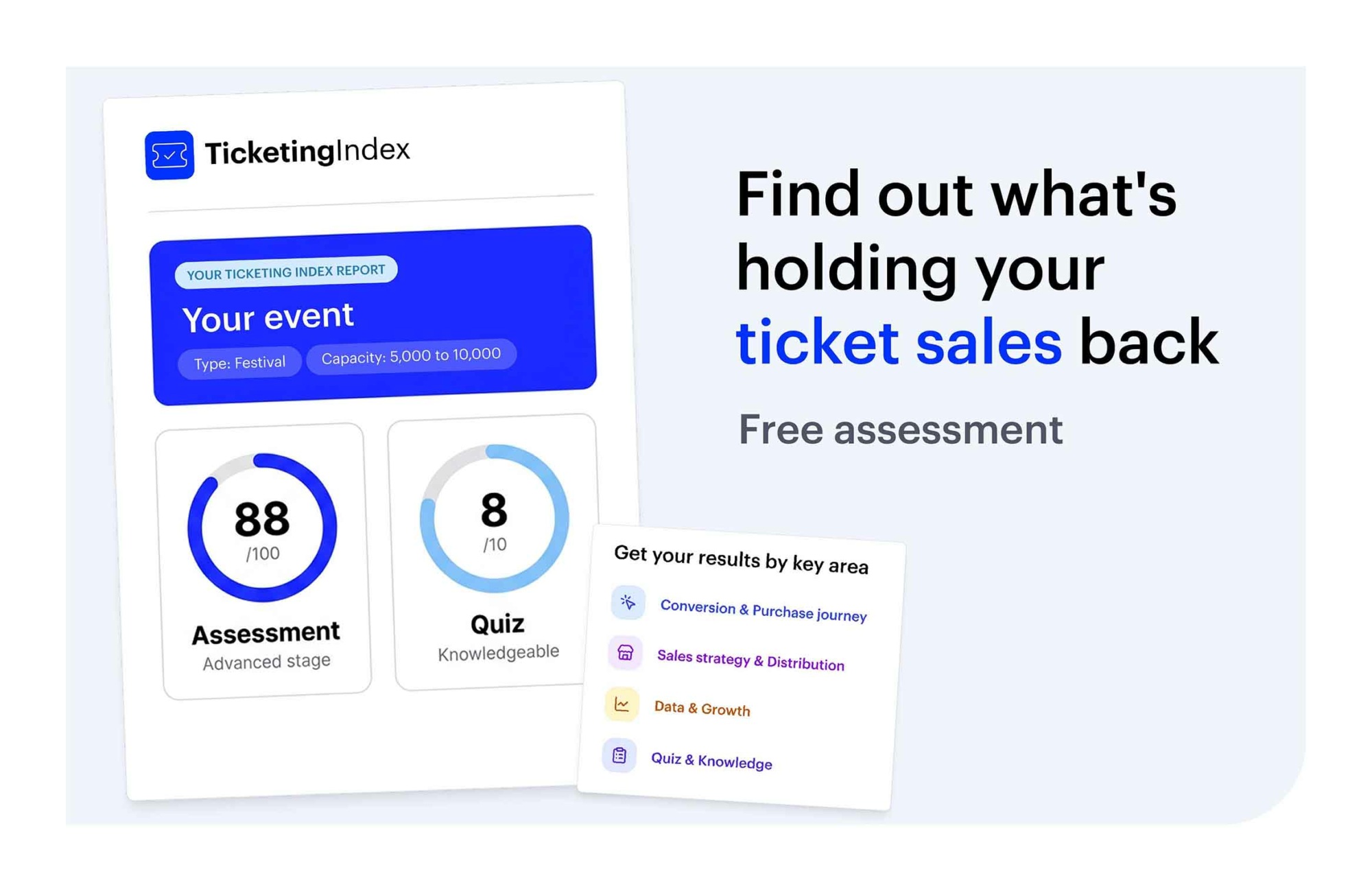
The Ticketing Index is a free 5-minute assessment that gives you a scored, personalised report on your ticketing setup, by event type, audience size, and current capability. Below is what it covers, why it’s worth knowing, and what the numbers say.
Summary
3 situations that look fine and aren’t
Gathered from real life situations
Festival organiser, tickets on sale, provider in place. The checkout redirects buyers to the provider’s interface, different colours, different fonts, a different URL. On the desktop, most buyers don’t notice. On mobile, where around 80% of ticket purchases now happen, it registers as leaving the website. That break in the experience can be enough to stall the decision. Conversion drops and there’s no alert, no error, nothing to investigate. Sales just come in slightly lower than they could have with a white-label website.
Conference organiser, post-purchase email goes out within minutes. It’s accurate, it’s clean, it has the ticket attached. It also has no upgrade offer, no pre-event add-on, no partner placement. The buyer just paid, opened the email, and read it start to finish. What was an opportunity ended up being a simple logistical notification. Cross-selling, when it’s set up correctly, adds an average of +15% revenue per order. A blank confirmation email captures zero of that.
Club or party venue, on-sale goes live, push goes out to the full list. There was no pre-registration form in the weeks before. The audience is cold. Conversion in the first hour is slower, cost-per-sale is higher, and the urgency mechanics that come from a warm list, people who raised their hand before sales opened, aren’t available. The pre-registration form takes minutes to set up. The list it builds converts faster and cheaper than anything acquired through paid channels in the same window.
None of these situations generate an obvious flag. They’re background losses, which is exactly what makes them worth diagnosing properly.
What the assessment covers
Conversion and the purchase journey
Every extra click in a checkout funnel costs approximately 1% in conversion. On an event selling 10,000 tickets, five unnecessary clicks is 500 incomplete transactions, from people who found the event, wanted to buy, started the process, and stopped.
The Index evaluates whether your checkout completes in under 15 seconds on mobile. Whether one-click payment is available, when it is, it accounts for nearly 1 in 2 transactions, a figure that surprises most people who assume it’s closer to 1 in 4. Whether buyer information is collected before or after payment. Before is friction. After is better conversion and more data, gathered at a moment when the buyer is engaged rather than being asked to jump through a hoop before they’ve paid.
It also asks whether buyers are required to create an account. Mandatory account creation sits among the highest drop-off triggers in any purchase funnel, and it’s still the default on several major platforms.
Sales strategy and distribution
In France, Belgium, and the Netherlands, 9 in 10 tickets are sold through the organiser’s own channels, website, email, social media. The implication is straightforward: the quality of your own sales infrastructure matters more than the distribution network of your provider.

This section looks at whether you can activate presales for restricted groups, members, loyal buyers, VIPs, quickly and without significant operational overhead. Whether your platform surfaces urgency natively: scarcity signals, availability indicators, limited-offer messaging. Whether you’re selling through physical points of sale, QR codes on print materials, and partner networks, or only through your website. Whether additional products like cashless credits, merchandise, experience upgrades, or parking can be added to the purchase with proper quota management, correct VAT treatment, and conditions tied to a specific ticket type.
To go further: “Why selling tickets directly is essential for event organisers”
Data and growth
A ticketing platform generates more usable buyer data than almost any other tool in the event marketing stack. For a lot of organisers, that data is either not being collected in a structured way, not segmented, or sitting in an export that nobody acts on.
The Index asks whether buyers are segmented by behaviour, recency, frequency, loyalty, not just by event attendance. Whether tracking pixels are deployed, so you’re working from a single attribution source rather than three platforms each claiming the same conversion. Whether campaigns are personalised to segment, or whether everyone gets the same email at the same time.
It also covers pre-registration. Capturing intent before sales open gives you a warm list that converts faster and at lower cost on launch day. It also tells you, before the on-sale, how much demand actually exists, which has operational value of its own.
Advanced capabilities
This section covers the setups that have the foundations in place and are working on the next layer.
- Virtual queues. When a high-demand on-sale opens, a queue needs to do more than absorb traffic. Entry rate, messaging, branding, capacity control, these are the levers that turn a stressful peak moment into a managed experience for the buyer. A generic queue from a provider’s default settings does roughly half of that job.
- Refundable tickets. In the UK, approximately 65% of festival buyers use instalment payments when the option is offered. Across markets, refundability removes a specific type of purchase hesitation, particularly for expensive tickets or events booked far in advance. An integrated refundable option, built into the checkout, works differently from a third-party insurance product that takes the buyer out of your flow and takes a margin cut on the way.
- Official resale. Secondary market resale, when it operates outside your platform, can cut primary revenue by up to 10%. When it’s integrated, with its own page, controlled activation timing, full price transparency, it functions as a reassurance mechanism that supports the primary sale rather than competing with it. The difference is in how it’s structured, not whether it exists.
- Post-purchase monetisation. The confirmation page and the post-purchase email are the most-read content in the entire buyer journey. Automatically inserted offers, upgrades, or partner placements at this moment generate revenue without any additional acquisition cost. A blank confirmation page is an infrastructure choice with a financial consequence.
The industry knowledge quiz
The Index also includes a 10-question true/false quiz. The score adjusts the personalisation of the results, higher knowledge, more advanced recommendations; lower score, more foundational guidance.
A few of the answers are worth stating plainly, because they’re frequently assumed wrong:
- When one-click payment is available, it’s used in nearly 1 in 2 transactions, not 1 in 4.
- Cross-selling generates an average of +15% revenue per order, not the 5% most people estimate.
- 8 in 10 organisers contact their ticketing provider in the three days before their event. Support quality and technical availability at peak moments are not secondary criteria when evaluating a platform.
- In the UK, around 65% of festival buyers choose instalment payments when the option exists.
The quiz results appear alongside the operational assessment in the final report, with explanations for each answer.
What the report gives you
The full report scores your setup across the four areas above and assigns one of three profiles, Early Stage, Growing, or Advanced, calibrated to your event vertical, audience size, and what the assessment found.
The profile isn’t a rating. A festival at Early Stage and a cultural venue at Early Stage are looking at different gaps and different priorities. The recommendations adjust for that.
The report is exportable and shareable. If you’re preparing for a conversation with your current provider about what’s missing, or evaluating whether to move to a different one, it gives you a structured baseline to work from.
Who gets the most from it
Organisers who have a sense that something isn’t working in their sales flow but haven’t been able to identify where.
- Event owners and promoters mid-way through evaluating a provider change who want a clearer picture of what the right setup actually looks like.
- Teams that are scaling, doubling capacity, moving from annual to recurring, expanding across markets, and need to know whether the current infrastructure will support that or create problems at the edges.
- And anyone who assumes 1 in 4 buyers use one-click payment when it’s available, and wants to know what else in the industry data they might be reading wrong.
There’s a natural instinct to do this kind of review after the next event, in a quieter window. The cost of waiting is specific: one more on-sale without a pre-registration list, one more post-purchase email that’s only a confirmation, one more checkout flow you haven’t pressure-tested on mobile.
The assessment takes five minutes.
Built by Weezevent, with 15+ years of experience across festivals, venues, stadiums, conferences, and live events in the UK, France, Belgium, the Netherlands, and beyond.